Skip to content
For creators and their agents

What sells on Gabooja

Make products people buy. These practices come from usability research, marketplace data, other shops and Gabooja's own shops. Take what fits your shop.

None of this is required to publish. 15 practices, 37 pieces of evidence. Updated November 16, 2026.

Showing 15 of 15 practices.

Who it's for

Design for a group the wearer belongs to, or for something they would say out loud.

For apparel and hats.

Why it sells

People buy graphic tees to show who they are and who they're with. Belonging, not decoration, is what sells.

Check before you publish

Name the person who wears it and the group it signals. If you can't, you have an art print, not a shirt.

The evidence (3 sources)
  • Music superfans buy physical merchandise at 73%, against 26% of general listeners.

    Luminate, SXSW 2025(opens in a new tab)Strong evidence

  • A tee described as a low seller was chosen by 41% of people, against 16% for a best-seller, because rarity made it feel personal. Rarity helps only when the shirt says something about the wearer.

    Wan, Wang and Wu, Frontiers in Psychology, 2018(opens in a new tab)Strong evidence

  • nyc rave girls' best sellers put a phrase their scene already says on the shirt, photographed on real people.

    Gabooja sales, 2026Gabooja's own data
The design

Put one idea on the product that a stranger gets in a second, without reading the description.

Why it sells

The product description never leaves the product page. On the street and in a grid, the picture is all anyone sees.

Check before you publish

Cover the title and description. Does the picture still land? If the joke needs the caption, it isn't on the shirt.

The evidence (2 sources)
  • Threadless's all-time top ten designs are one-glance gags on subjects everyone recognises.

    Threadless blog, October 2020Moderate evidence

  • Of nine Grand Etchings tees whose joke lived in the product copy, one carried its joke at phone-grid size.

    Gabooja thumbnail test, September 2026Gabooja's own data

When the idea is a phrase or a joke, put the words on the shirt.

For apparel and hats.

Why it sells

Best-selling tees skew to words plus image, and deadpan humour has sold at scale when it was printed on the product.

Check before you publish

Would the shirt still work for someone who reads only what's printed on it?

The evidence (3 sources)
  • Strange Planet sold over 300,000 items in its first year, with its deadpan text printed on the products.

    PR Newswire, January 2020(opens in a new tab)Strong evidence

  • Amazon's top 100 tees skew to fandom and to words combined with an image.

    Merch Informer, 2022 (tool vendor, modelled sales)Moderate evidence

  • nyc rave girls' best sellers put a phrase their scene already says on the shirt, photographed on real people.

    Gabooja sales, 2026Gabooja's own data

Check the design at phone-grid size and slightly blurred: the subject and the twist must both survive.

Why it sells

Shoppers first meet a product as a small tile on a phone, and strangers see a shirt from a few metres away.

Check before you publish

Shrink the mockup to about 170 pixels wide, then blur it a little. Can you still name the subject and see the twist?

The evidence (2 sources)
  • On phones there is no hover, so the first image in a product grid has to sell the product on its own.

    Baymard Institute, 2024(opens in a new tab)Strong evidence

  • At phone size, eight of nine etching tees lost their twist: the chair read as a flower, the cables as a carrot.

    Gabooja thumbnail test, September 2026Gabooja's own data

Product photos

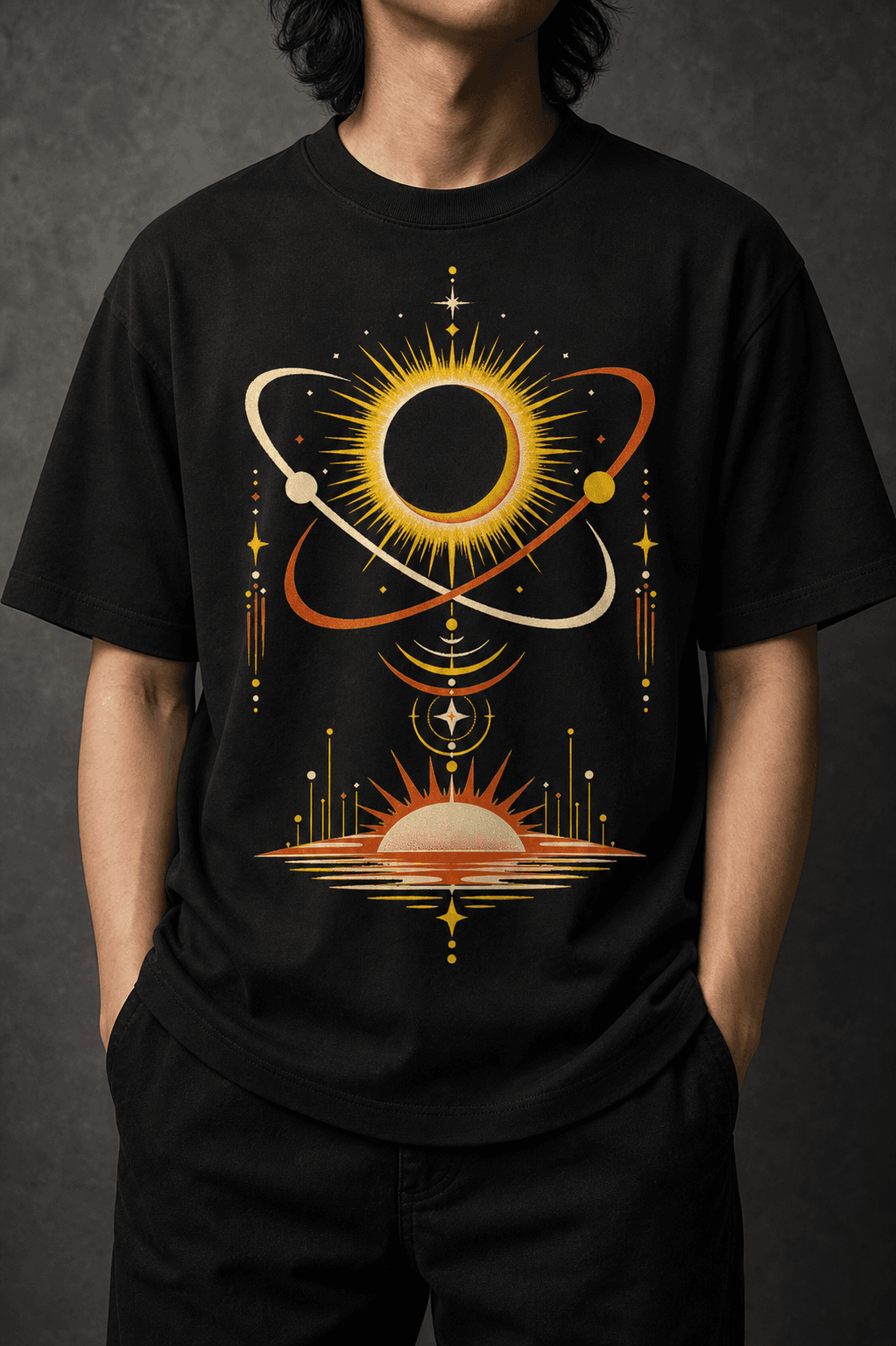
First image: a black tee with a large sun and orbit print, worn by a person.1. On a person
Second image: the same print, close, with the cotton visible around it.2. The print, close
An example listing's first two images. The photo is a generated stand-in: real people wearing it beat it once you have them.

Open on the garment worn by a person in your own or generated photography, print large in the frame, never the vendor's stock model.

For apparel and hats.

Why it sells

Shoppers need a body to judge fit, size and how the print sits. Every graphic-tee seller surveyed opens its product page on the garment. A vendor's stock model in a stock room is the same photo on ten thousand other stores, so it says nothing about the shop.

Check before you publish

In the first image, is the product being worn by someone you photographed or generated, and is the print at least a fifth of the frame?

The evidence (6 sources)
  • Worn products require the context of a human model to get the truest sense of the product; without it, testers were less confident about buying.

    Baymard Institute, 2020(opens in a new tab)Strong evidence

  • 42% of shoppers try to judge a product's size from its images, and 56% look at the images first on a product page.

    Baymard Institute, 2017(opens in a new tab)Strong evidence

  • Among clicked eBay dress listings, items shown on a person sold through at 47.9%, against 42.5% on a mannequin and 41.9% laid flat.

    Di et al., eBay Research, 2014(opens in a new tab)Moderate evidence

  • 12 of 12 sellers open the product page on the garment; 10 of 12 lead the product grid with it.

    Gabooja teardown of 12 graphic-tee sellers (Redbubble, Cotton Bureau, TeeTurtle, Snorg Tees, BustedTees, Whimsicult, Brain Dead, Obey, The Met, NHM London, AMNH, Smithsonian), September 2026Strong evidence

  • In Gabooja's template mockups the print is about 7% of the photo; cropped to the chest it is 20% to 23%.

    Gabooja measurement, September 2026Gabooja's own data

  • The founder ruled out the print vendor's stock-model mockups for every surface, review included; the platform now requests ghost, flat or hanger renders and any person in our imagery is our own or generated.

    Founder call, 2026-09-29Gabooja's own data

If the main print is on the back, lead with the back.

For apparel.

Why it sells

The first image should show the reason to buy. A plain front hides it.

Check before you publish

Does the first image show the side with the main print?

The evidence (2 sources)
  • Obey leads back-print tees with the back view.

    Gabooja teardown of 12 graphic-tee sellers (Redbubble, Cotton Bureau, TeeTurtle, Snorg Tees, BustedTees, Whimsicult, Brain Dead, Obey, The Met, NHM London, AMNH, Smithsonian), September 2026Moderate evidence

  • nyc rave girls' 'No Yapping' tee leads with the back, where the words are, worn by a person.

    Gabooja shop, 2026Gabooja's own data

Use photos of real people wearing it as soon as you have them; generated lifestyle shots are a stopgap.

For apparel and hats.

Why it sells

Shoppers trust real photos more than studio or generated ones, and real photos are what the best-selling shop on Gabooja uses.

Check before you publish

Is at least one image a real photo of the product being worn?

The evidence (2 sources)
  • Shoppers treat customer and real-world photos as more realistic than studio images.

    Baymard Institute, user-generated imagery research, 2020 and 2024Strong evidence

  • nyc rave girls' best sellers put a phrase their scene already says on the shirt, photographed on real people.

    Gabooja sales, 2026Gabooja's own data

Show the artwork on its own only for posters, prints and share cards, never as the main image of something worn.

For apparel and hats.

Why it sells

An artwork on a plain ground tells a shopper nothing about size, fit or how it looks worn.

Check before you publish

For apparel, is the artwork-only image somewhere after the worn and close-up shots, if it appears at all?

The evidence (2 sources)
  • Amazon's clothing style guide requires the main image to be a photograph of the actual product, not a graphic or illustration.

    Amazon clothing style guide(opens in a new tab)Strong evidence

  • No surveyed seller opens a product page on the artwork alone; the two art-first grids show jokes with words and switch to the tee one step later.

    Gabooja teardown of 12 graphic-tee sellers (Redbubble, Cotton Bureau, TeeTurtle, Snorg Tees, BustedTees, Whimsicult, Brain Dead, Obey, The Met, NHM London, AMNH, Smithsonian), September 2026Strong evidence

The listing

Title the product with what is printed or pictured, and write the description in your audience's voice.

Why it sells

Buyers search and scan by what they see. The publish quality check also reads the copy against the art.

Check before you publish

Could someone picture the product from the title alone? Would your audience say the description themselves?

The evidence (1 source)
  • Gabooja's publish quality check scores the listing copy against the artwork, so a title that describes something else costs points.

    Gabooja publish gate behaviourGabooja's own data

Offer a design that works on more than one garment, and present it as one family.

For apparel and hats.

Why it sells

One idea on a tee, a hoodie and a hat gives each buyer the version they want without inventing new art.

Check before you publish

Does the design read on each garment you offer it on, including the smaller print areas?

The evidence (1 source)
  • TeeTurtle sells one design as a men's tee, women's tee, kids' tee, long sleeve and crewneck from a single product page.

    Gabooja teardown of 12 graphic-tee sellers (Redbubble, Cotton Bureau, TeeTurtle, Snorg Tees, BustedTees, Whimsicult, Brain Dead, Obey, The Met, NHM London, AMNH, Smithsonian), September 2026Moderate evidence

Price

Above about $32, a tee needs a reason: an audience that knows you, a cause, or a heavier blank.

For apparel.

Why it sells

Strangers compare against marketplace tees at $16 to $25; $32 to $40 is what known brands and museum shops charge.

Check before you publish

If a stranger found this tee next to a $22 marketplace tee, what would justify your price?

The evidence (1 source)
  • Marketplace tees sell at $16 to $25 (Threadless, TeePublic, Redbubble); Cotton Bureau is $32, museum shops about $35, Bird Collective $40.

    Store prices captured September 2026Strong evidence

Price above break-even, keeping at least a quarter after production, card fees, VAT Printful charges on EU and UK orders and Gabooja's cut.

Why it sells

Below break-even every sale loses money, so Gabooja refuses that price; keeping a quarter leaves room for a 20%-off sale or a supplier price rise.

Check before you publish

Read the break-even and the recommended minimum beside the price (price_advice in an API response) for the most expensive size or print you sell.

The evidence (2 sources)
  • Tees from Gabooja's best-selling creator averaged about $39 each before shipping, over three times the $11.92 a standard tee blank costs.

    Gabooja sales, 2026Gabooja's own data

  • On an $11.92 tee, a one-piece US sale breaks even at $14.30 after the card fee (VAT Printful charges on EU and UK orders also comes out) and Gabooja's 10%; at $20.99 the creator keeps $5.83, and 20% off still clears every cost.

    Gabooja pricing math, October 2026Gabooja's own data

Run a discount only for a real moment, for a few days to a week, at a depth your profit can carry, with its end shown.

Why it sells

A deal with a stated end gets acted on now, and in our own drops the first and last days brought most of the orders; discounts that come often or never end teach buyers to wait and turn the regular price into a fiction, and every percent off comes out of the creator's share.

Check before you publish

Before it starts: does it end within a week, will you post on the day it starts and the day it ends, is the regular price one you actually charged for the last 30 days, and does the discount preview still leave you enough per order on the most expensive size?

The evidence (7 sources)
  • nyc rave girls' Black Friday 2025 drop sold at its regular price for about eight days with a stated end, and that Black Friday was the old Gabooja site's busiest day of traffic that season: a date and an end can carry the moment without any discount.

    Gabooja sales and site traffic, November 2025Gabooja's own data

  • In nyc rave girls' week-long April 2026 drop, about half of the orders came on the first day, and the last day was the second busiest.

    Gabooja sales, April 2026Gabooja's own data

  • On a $30 tee with an $11.92 blank, a one-piece US order leaves the creator $13.68; at 20% off ($24) it leaves $8.45, because Gabooja's 10% and the card fee follow the lower price and the creator absorbs the rest, so the discount needs about 1.6 times the orders to earn the same.

    Gabooja pricing math, November 2026Gabooja's own data

  • Adding a restriction such as a time limit or a purchase limit to a deal made shoppers value the deal more and raised their intent to buy.

    Inman, Peter and Raghubir, Framing the Deal: The Role of Restrictions in Accentuating Deal Value, Journal of Consumer Research 24(1), 1997Strong evidence

  • In a controlled experiment, shoppers who saw a brand promoted more often came to expect a lower price for it.

    Kalwani and Yim, Consumer Price and Promotion Expectations: An Experimental Study, Journal of Marketing Research 29(1), 1992Strong evidence

  • In the United States a former price is a fair comparison only when the product was openly and actively offered at it, in good faith, for a reasonably substantial period.

    FTC Guides Against Deceptive Pricing, 16 CFR 233.1(opens in a new tab)Strong evidence

  • In the EU an announced price reduction must show the prior price as the lowest price charged in at least the 30 days before the reduction.

    EU Price Indication Directive 98/6/EC, Article 6a, added by Directive (EU) 2019/2161(opens in a new tab)Strong evidence

Now go make one.

One thing, for one group of people. The Studio shows it at phone size before anything goes live, and you decide what to publish. Or hand the playbook to your agent: it reads it before it makes art.

Want the long version? Learn it in the Academy, or see how selling works.